What Happens Before an Aircraft Takes Off for the First Time?
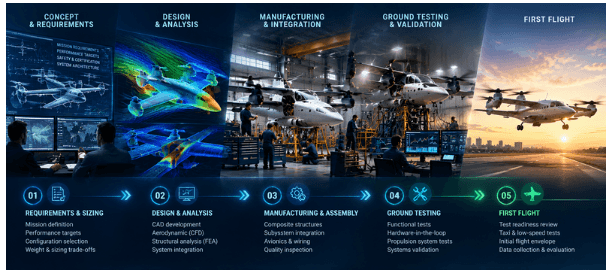
1. The Ground Verification Imperative
To the casual observer, the maiden flight of a new aircraft appears as an act of courageous triumph—an experimental prototype rolling out onto the tarmac, advancing power, and lifting effortlessly toward the clouds. In truth, from the perspective of an aerospace engineer, a first flight contains zero room for theatrical bravery or unforeseen aerodynamic surprises. By the time a prototype leaves the runway surface, every primary load path, electrical wiring harness, hydraulic actuator, and lines-of-code control law has been rigorously stressed, shaken, burned-in, and mathematically validated through hundreds of hours of ground testing.
The period spanning final structural assembly to wheels-up is among the most demanding phases in any aerospace development program. It serves as the physical reality check for thousands of computational fluid dynamics simulations and finite element models. Modern aircraft systems are profoundly coupled: aerodynamic surface deflections interact with structural aeroelastic flexing, which directly impacts the gain parameters of digital flight control computers. Proving that these multi-physics interactions behave predictably while firmly anchored to the earth is the fundamental purpose of the pre-flight testing regime.
2. Structural Proof and Ground Vibration Testing (GVT)
Before an airframe can ever be powered on the runway, its raw structural integrity must be validated against extreme mechanical forces. The airframe is locked inside a structural test rig lined with computerized hydraulic jacks, load cells, and laser deflection meters. Engineers subject the wing spars, carry-through bulkheads, and control surface attachment lugs to the "Limit Load"—the absolute maximum mechanical force the aircraft is statistically calculated to encounter across its certified operational lifespan. Structural engineers verify that composite and metal elements flex within predicted tolerances and return completely to their original geometry with zero permanent plastic deformation.
Following static loads, the prototype undergoes Ground Vibration Testing (GVT). Flutter—a violent, self-sustaining aeroelastic oscillation where aerodynamic energy feeds structural flexing until structural failure occurs—is among the most hazardous risks facing high-speed flight. To prevent flutter, the prototype is suspended on soft, elastic bungees or pneumatic pads to simulate free-flight boundary conditions. Electrodynamic shakers attach to the wingtips, vertical stabilizers, and propulsion nacelles, injecting sinusoidal frequency sweeps through the structure. Accelerometers positioned across the airframe measure resonant natural frequencies and structural damping ratios, confirming that aerodynamic forces in flight cannot inadvertently couple with the airframe's natural modes.
3. Systems Rig Testing, Iron Bird, and HIL Emulation
Parallel to airframe structural qualification, the aircraft's internal nerve center is tested within the "Iron Bird"—a ground-based skeletal rig matching the exact geometric layout of the aircraft. On the Iron Bird, all actual flight-standard hardware is installed: Fly-By-Wire flight control computers, hydraulic actuators, electric motors, primary power buses, and cockpit controls. Dynamic load cylinders push against the actuators, resisting control surface movement to simulate real aerodynamic pressures encountered at various airspeeds.
Hardware-in-the-Loop (HIL) simulators feed simulated sensor data into the flight control computers, tricking the aircraft into thinking it is flying through crosswinds, severe turbulence, and abrupt attitude upsets. Flight control engineers inject intentional systemic failures: disabling one of three inertial measurement units (IMUs), severing a primary power line, or jamming an aileron actuator. The automation software must demonstrate fail-operational redundancy, isolating faults and executing safe control hand-offs without pilot intervention.
Testing Phase | Engineering Execution & Environment | Pass Criteria & Critical Failure Mitigations |
Proof & Limit Loading | Hydraulic rams apply spanwise bending moments | Zero permanent set; spar deflection within FEA limits |
Ground Vibration (GVT) | Electrodynamic shakers drive structural sweeps | Validation of modal frequencies and flutter margins |
Powertrain Tie-Down | Maximum thrust / torque hold against tie-down cables | Thermal equilibrium, fuel/battery draw, vibration balance |
Low-Speed Taxi Runs | Tarmac maneuvering at 10 to 30 knots | Nosewheel steering tracking, brake fade, gear shimmy |
High-Speed Aborted Take-Off | Rapid acceleration to rotation speed (Vr) followed by abort | Dynamic elevator authority verification & emergency braking |
4. Static Engine Runs and Taxi Trials: Stepping onto the Runway
Once installed on the actual flight article, the propulsion system undergoes outdoor tie-down tests. The airframe is secured to reinforced ground anchors while engines or electric propulsion units are run up to 100% full power. Engineers monitor cooling margins, fluid line pressures, thermal dissipation around battery compartments, and electrical bus harmonics under peak demand.
With tie-down runs signed off, the aircraft taxies under its own power. Low-speed taxiing verifies that ground steering authority is positive and nosewheel shimmy damping is effective. The test pilot then executes progressive high-speed taxi tests along the runway centerline. Accelerating to 70%–90% of rotation velocity (Vr), the pilot exercises aerodynamic control surfaces: the rudder is deflected to assess directional authority in the propwash, and the control stick is pulled back to momentarily relieve weight from the nose landing gear, confirming pitch authority before cutting throttle and testing maximum braking deceleration.
5. The Flight Readiness Review (FRR) and Final Sign-Off
The final hurdle before flight is administrative and collaborative: the formal Flight Readiness Review (FRR). In this closed-door review, Chief Engineers, aerodynamics leads, structural analysts, systems software directors, and the experimental test pilot review every data trace from the ground testing campaign. Every open anomaly or test discrepancy must be formally resolved or assigned an acceptable safety risk mitigation.
Only when every engineering discipline unanimously signs the Flight Test Permit does the aircraft receive clearance to line up on the runway. When the aircraft finally rotates and takes flight, it is not taking a leap into the unknown; it is simply executing the logical physical conclusion of thousands of hours of rigorous ground preparation.
KEY ENGINEERING TAKEAWAY - First flights do not test whether an aircraft can fly; they confirm what months of static proof loading, ground vibration testing, hardware-in-the-loop simulation, and high-speed taxi runs have already proven on the ground.