Why Some eVTOLs Choose a Box Wing Configuration
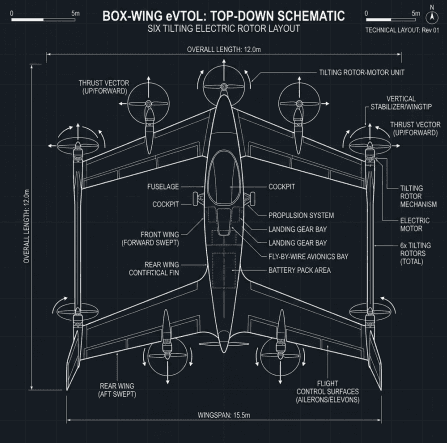
1) Beyond Drag Reduction: Practical eVTOL Engineering
When engineers evaluate airframe configurations for Electric Vertical Take-Off and Landing (eVTOL)
aircraft, they must look beyond simple drag values. While the aerodynamic benefits of closed-loop
wings--such as the suppression of wingtip vortices--are substantial, a box-wing configuration solves
several practical, multi-disciplinary engineering problems that are unique to vertical flight. Designing an aircraft that must transition from a hovering helicopter to a cruising airplane requires a highly versatile airframe. The box-wing layout provides a structural and geometric foundation that addresses the challenges of rotor mounting, stability, control, and multi-regime load management.
2) Solving the Rotor Mounting and Balance Challenge
A major design challenge for eVTOL aircraft is the placement of multiple tilting rotors. These rotors
must point upward to provide vertical lift during hover, and then tilt forward to provide horizontal
propulsion during cruise. Mounting several large, heavy tilting rotors on a single conventional wing
creates significant stability issues. The weight is concentrated along a single horizontal axis, making
the aircraft highly sensitive to pitch imbalances. A box-wing configuration solves this by providing two
separate lifting surfaces--a forward wing and a rear wing. This layout allows engineers to distribute the tilting rotors across both wings, balancing weight and thrust vectors more evenly around the aircraft's center of gravity.
3) Taming Torsional Twisting in Transition Flight
The transition phase between hover and cruise exposes the aircraft's wings to extreme aerodynamic
forces. As the rotors tilt forward, they generate massive thrust vectors that are perpendicular to the
wing's chord line. On a conventional cantilevered wing, this off-axis thrust creates significant torsional
(twisting) stress. To prevent the wings from twisting or fluttering, conventional wings must be
reinforced with heavy internal structures. A box-wing configuration naturally resists these torsional
forces. The vertical connecting fins at the wingtips link the front and rear wings, forming a rigid
closed-loop structure. This structural loop prevents individual wings from twisting, managing torsional
loads with minimal material.
4) Ground Effect and Structural Rigidity
eVTOL aircraft operate close to the ground during take-off and landing, exposing them to turbulent
ground effects. The high-velocity downwash from the rotors hits the ground and bounces back,
creating chaotic aerodynamic disturbances underneath the fuselage. The rigid truss structure of a
box-wing is highly resistant to the bending and flexing forces caused by these downwash currents.
Additionally, the closed loop design provides a natural cage-like structure around the rotating rotors,
which can help shield the fuselage from debris and reduce the acoustic noise footprint generated by
the rotor-wing aerodynamic interactions.
Focus: The Tilt-Rotor Integration of the Nalwa
The Nalwa Aero project illustrates this engineering logic. As a heavy-lift tactical logistics eVTOL, the
Nalwa carries a heavy payload that requires significant rotor thrust. A box-wing configuration
was chosen to mount its tilting rotors. By spreading the rotors across the front and rear wings, the
design team achieved a well-balanced thrust distribution. The vertical connecting fins provide the
torsional stiffness required to handle the changing forces as the rotors tilt during transition, ensuring
structural safety. This design demonstrates how the box-wing layout provides a strong, compact, and structurally efficient airframe that meets the demands of both helicopter and airplane flight regimes.
The Nalwa Aero Approach
At Nalwa Aero, our approach to aircraft development is centred on solving the engineering challenges that come with building a new form of electric air mobility. The box-wing is an important part of that approach. Combined with distributed tilting propulsion, the configuration provides a foundation for balancing propulsion forces, managing structural loads and supporting the aircraft through hover, transition and cruise. Our fly-by-wire flight computer, autonomous capabilities and envelope protection further contribute to the aircraft's ability to manage its different operating conditions.
The goal is not to adopt technology simply because it looks futuristic. Every major design decision needs an engineering reason behind it.
The box-wing is one example of that thinking: a configuration selected not merely for appearance, but because its geometry can address several interconnected requirements of an eVTOL aircraft.
Why Configuration Matters
In aircraft development, individual technologies rarely operate in isolation. Propulsion influences structure. Structure influences weight. Weight influences performance. Aerodynamics influence range. Flight controls influence stability. The aircraft has to work as one system.
That is why the choice of airframe configuration is so important.
For Nalwa Aero, the box-wing creates a framework in which these different engineering requirements can work together. Its forward and rear lifting surfaces allow distributed propulsion to be positioned across the aircraft, while its connecting structures contribute to rigidity and load management. The result is a configuration designed around the realities of vertical take-off, transition and efficient forward flight.
Engineering the Transition
The most interesting part of an eVTOL is not simply that it can take off vertically. It is what happens next. Moving from hover to forward flight requires propulsion, aerodynamics, structures and control systems to work together seamlessly. The aircraft's configuration plays a central role in making that possible. For Nalwa Aero, the box-wing represents this systems-level approach to aircraft design.
It provides a way to integrate multiple tilting propulsion units, distribute forces across the airframe and manage the structural demands created during transition. Ultimately, the box-wing is not just a shape.
It is an engineering decision designed around how the aircraft needs to fly.