Beyond Drag Reduction: The Engineering Behind Nalwa Aero’s Box-Wing eVTOL
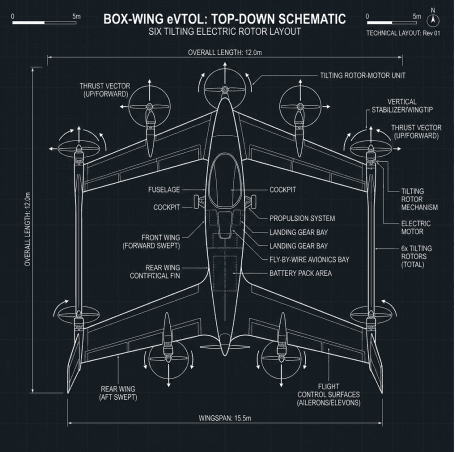
When engineers evaluate electric vertical take-off and landing (eVTOL) aircraft, aerodynamic efficiency is only one part of the challenge. Drag, lift, wingtip vortices, and cruise efficiency are important, but an eVTOL must also solve a much more complex problem: how to transition safely and efficiently between vertical flight and conventional forward flight.
At Nalwa Aero, this challenge is addressed through an integrated aircraft architecture combining an 8-tilting-propulsion system, box-wing configuration, advanced fly-by-wire flight controls, and autonomous capabilities.
The Nalwa eVTOL is designed with four tilting rotors on the front wing and four on the rear wing. This distributed propulsion architecture works together with the interconnected box-wing structure to address propulsion integration, structural loads, stability, and performance across different flight regimes.
For Nalwa Aero, therefore, the box wing is not simply an aerodynamic solution for reducing drag. It is an important part of a broader engineering philosophy: designing the aircraft as an integrated system.
1. Why Box-Wing Architecture Matters for eVTOL Aircraft
A conventional aircraft typically relies on a single main wing supported by a fuselage and, depending on the configuration, a separate tail. A box-wing aircraft uses two lifting surfaces connected at their outer sections, creating a closed-loop aerodynamic and structural arrangement.
One potential aerodynamic benefit is improved management of the aircraft's induced drag and wingtip-vortex characteristics. However, for an eVTOL aircraft, the structural and propulsion-integration benefits can be equally important.
An eVTOL needs to accommodate multiple motors, rotors, batteries, flight-control systems, landing gear, payload, and other aircraft systems while remaining lightweight and structurally efficient.
The aircraft must also withstand very different loads during hover, transition, and cruise.
The box-wing architecture gives Nalwa Aero an additional structural framework for addressing these requirements. The front and rear wings can work together while providing multiple locations for integrating the aircraft's propulsion system.
This makes the configuration particularly relevant to tilt-rotor eVTOL technology, where propulsion forces continuously change direction throughout the transition from vertical to horizontal flight.
2. Eight Tilting Rotors and Distributed Propulsion
One of the defining features of the Nalwa eVTOL is its eight-rotor tilting propulsion system.
Four rotors are positioned on the front wing and four on the rear wing. During vertical flight, the rotors are oriented to generate the thrust required for take-off and landing. As the aircraft accelerates, the propulsion units progressively tilt forward, shifting the aircraft from vertical lift toward horizontal propulsion.
This creates a unique aircraft-control challenge.
The direction of thrust changes continuously, while aerodynamic forces increase as the aircraft gains speed. The aircraft therefore needs to maintain stability while simultaneously managing changing propulsion and aerodynamic forces.
Distributing the eight rotors across the front and rear wings provides Nalwa eVTOL with a balanced propulsion arrangement around the aircraft's center of gravity.
This approach can help distribute thrust and propulsion loads across the airframe rather than concentrating the entire propulsion system on one wing.
For a heavy-lift eVTOL aircraft, this becomes especially significant. Nalwa eVTOL is being developed around a target payload capability of up to 1,000 kg, making efficient propulsion integration and structural load management critical to the overall aircraft design.
3. Managing Loads During eVTOL Transition
Transition flight is one of the most demanding phases of eVTOL aircraft operation.
During hover, the propulsion system generates predominantly vertical thrust. As the rotors tilt forward, the thrust vectors change direction. At the same time, the wings begin producing increasing amounts of aerodynamic lift as airspeed builds.
This means that the aircraft structure must handle constantly changing combinations of thrust, bending, and torsional loads.
On a conventional cantilevered wing, a propulsion unit mounted away from the primary structural axis can generate significant twisting forces. Managing these loads can require additional structural reinforcement, which can increase weight.
The interconnected geometry of a box-wing structure provides an alternative load path.
The front and rear wings are connected through the outer structures, creating a closed structural loop. Loads introduced into one lifting surface can therefore be transferred through the interconnected structure.
For Nalwa Aero's tilt-rotor eVTOL, this architecture is particularly relevant during transition, when propulsion forces change direction and the aerodynamic environment changes rapidly.
Structural stiffness is not only important for safety. Maintaining the intended geometry of the aircraft also helps ensure that the aerodynamic surfaces behave predictably across the flight envelope.
4. Fly-by-Wire Control for Multiple Flight Regimes
An advanced eVTOL aircraft must operate across several distinct flight regimes.
During vertical take-off and landing, the aircraft relies heavily on rotor thrust and precise control of individual propulsion units. During transition, aerodynamic lift gradually becomes more significant while rotor thrust changes direction. During cruise, the aircraft increasingly behaves like a conventional fixed-wing aircraft.
Managing these transitions requires sophisticated flight-control technology.
Nalwa eVTOL incorporates an advanced fly-by-wire flight-control system designed to manage aircraft response throughout these different operating conditions.
The system is also being developed with autonomous capabilities and flight-envelope protection. This approach is intended to help manage the aircraft's operating limits while supporting consistent and controlled flight across different phases of operation.
With eight tilting rotors, coordinated control becomes particularly important. Changes in rotor angle can influence thrust magnitude, thrust direction, aircraft moments, and overall flight dynamics.
The integration of propulsion and flight controls is therefore a fundamental part of Nalwa Aero's approach to advanced eVTOL aircraft development.
5. Ground Operations and Structural Rigidity
Vertical take-off and landing introduce aerodynamic conditions that conventional aircraft encounter less frequently.
When an aircraft hovers close to the ground, rotor downwash interacts with the surface below and produces complex airflow around the aircraft. This can influence rotor performance, stability, noise, and the aerodynamic environment surrounding the airframe.
A rigid, interconnected wing architecture can provide a strong structural foundation for handling the changing forces associated with these operating conditions.
The box-wing configuration also provides additional opportunities for integrating propulsion components and other aircraft systems within the overall aircraft geometry.
These characteristics do not eliminate the aerodynamic challenges associated with ground effect or rotor-wing interaction. Instead, they provide engineers with an integrated airframe architecture through which these challenges can be analyzed and managed.
For Nalwa Aero, this is part of the broader objective of creating an eVTOL platform engineered for real-world operations, rather than optimizing the aircraft for only one flight condition.
6. One Platform, Multiple Missions
The engineering philosophy behind Nalwa eVTOL extends beyond flight performance.
The platform is being developed as a multi-role eVTOL aircraft, with the ability to support different mission configurations. Its architecture is intended to accommodate applications including:
Cargo transportation
Air ambulance operations
Commuter transportation
VIP transportation
This flexibility is particularly important for the future of advanced air mobility.
Different missions require different payload arrangements, cabin configurations, equipment, and operational requirements. A flexible aircraft platform can potentially support multiple applications without requiring an entirely different aircraft architecture for every mission.
Nalwa Aero's approach combines the structural benefits of the box-wing configuration with distributed propulsion and advanced flight controls to create a foundation for this multi-role capability.
7. Engineering for Electric and Hybrid Propulsion
Energy efficiency is another critical consideration in the development of electric aircraft.
Battery-powered aircraft are highly sensitive to weight and aerodynamic efficiency because available onboard energy directly influences range and payload capability.
Nalwa eVTOL is being developed with a target 450 km full-electric range, enabled by advanced battery technology. Nalwa Aero is also exploring a hybrid hydrogen propulsion configuration targeting more than 1,500 km of range.
These propulsion options reinforce the importance of an integrated aircraft design.
Aerodynamic efficiency, structural weight, propulsion efficiency, and energy storage cannot be optimized independently. Improvements in one area can influence the performance requirements of another.
This is why Nalwa Aero's eVTOL architecture focuses on bringing the airframe, propulsion, flight controls, and mission requirements together from the beginning.
8. Nalwa Aero’s Integrated Approach to eVTOL Engineering
The development of a practical eVTOL aircraft requires engineers to solve multiple problems simultaneously.
The propulsion system must provide sufficient vertical thrust. The airframe must manage changing loads. The wings must provide efficient lift during cruise. The flight-control system must maintain stability throughout transition. And the overall aircraft must remain lightweight enough to achieve useful range and payload capability.
Nalwa Aero's architecture addresses these requirements through the combination of:
8 tilting rotors + box-wing architecture + fly-by-wire flight controls + autonomous capabilities + envelope protection + multi-role configuration.
Each element contributes to the overall aircraft rather than functioning as an isolated technology.
The box wing provides the aerodynamic and structural foundation. The eight tilting rotors provide distributed propulsion for vertical and forward flight. The fly-by-wire system coordinates the aircraft's response, while autonomous capabilities and envelope protection support intelligent flight management.
Together, these technologies create the foundation for Nalwa's next-generation eVTOL aircraft platform.
Conclusion
The future of electric vertical take-off and landing aircraft will not be defined by a single component or technology.
Successful eVTOL development requires the integration of aerodynamics, propulsion, structures, flight controls, energy systems, and mission requirements into one coherent aircraft.
At Nalwa Aero, the box-wing configuration is being developed with this philosophy in mind.
Its purpose extends beyond aerodynamic efficiency. The interconnected structure provides a framework for integrating eight tilting rotors, distributing propulsion across the aircraft, managing changing loads during transition, and supporting a flexible multi-role platform.
Combined with advanced fly-by-wire flight controls, autonomous capabilities, envelope protection, a 1,000 kg payload target, 450 km full-electric range, and a future hybrid-hydrogen propulsion concept targeting 1,500+ km, the Nalwa eVTOL represents an integrated approach to next-generation aircraft development.
From vertical take-off to forward cruise, every part of the aircraft must work together.
That is the engineering philosophy behind Nalwa Aero: building an eVTOL aircraft not by optimizing individual components in isolation, but by designing the entire aircraft as one integrated system.